A previously unrecorded manuscript related to the posthumous Rubens inventory.
A controlled scholarly introduction to a rare handwritten witness under active study. Material evidence, textual comparison with known printed editions, and institutional dialogue are the three pillars of the research.
Controlled
Disclosure
Only selected details are shared publicly. Full images, transcription, and unpublished research are reserved for appropriate scholarly or institutional review.
Research
First
The project is framed around verification, comparison, material analysis, and scholarly dialogue — not market claims or premature conclusions.
Publication
Potential
The manuscript may offer valuable evidence for the transmission, copying, and reception of the Rubens estate catalogue tradition across the seventeenth century.
Sir Peter Paul Rubens
1577–1640
Painter, diplomat, collector, builder — Rubens assembled one of the greatest private collections of the seventeenth century. His death on 30 May 1640 set in motion the documentary tradition this project explores.
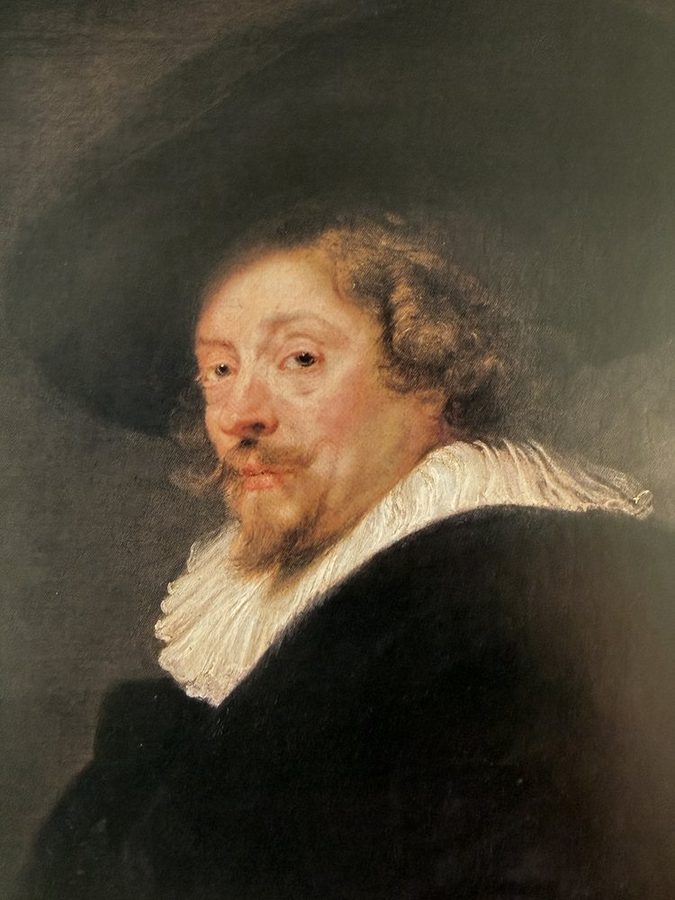
The posthumous inventory of his estate — the Spécification des Peintures — recorded 314 numbered paintings entries, followed by drawings, sculpture, ivory works, and decorative objects. The collection had been a working tool as much as a treasury: a visual library in which Rubens hung his own work alongside originals by Titian, Tintoretto, Raphael and Bruegel.
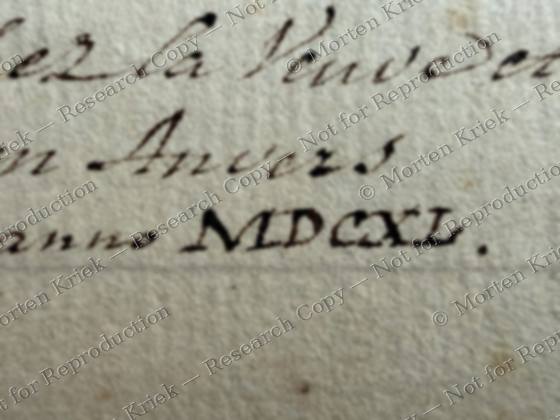
Potentially among the earliest witnesses — and the only one in manuscript form so far recorded.
This manuscript preserves hundreds of entries relating to paintings, drawings, sculpture, and rare objects — the collecting world surrounding Rubens after his death in 1640.
Not recorded in the published scholarly literature reviewed to date, it appears to introduce new evidence into the Rubens estate catalogue tradition — previously known only from printed witnesses or later institutional copies.
A restrained public door into serious research
This microsite is carefully structured: sufficient for scholars, sufficiently reserved to protect the object.
Significance
Why this document may matter to the history of Rubens's collection, catalogue transmission, and seventeenth-century archival practice.
The Object
A factual presentation of the manuscript's physical and textual features, current research status, and access conditions.
Evidence & Method
How the document is being assessed through material study, collation, and external scholarly consultation.
Comparative Witnesses
Context provided by known institutional copies and the research method that governs comparison.
Why this manuscript may matter.
Its bearing on the history of Rubens's collection, catalogue transmission, and seventeenth-century archival practice — and what can and cannot yet be stated with confidence.
The purpose of this site is deliberately limited: to introduce the object with appropriate precision, outline the open research questions, and invite qualified dialogue. It is not a claims document. Every statement here reflects the current state of knowledge, and is marked accordingly.
The manuscript closes with a dated colophon, written in a slightly more formal hand, that names the vendors, the location, and the printer of the 1640 edition. That closing line — and why the printer’s name carries independent evidentiary weight — is set out in the sample evidence panel and the scholarly-context section below. It is among the most significant details under scholarly review.
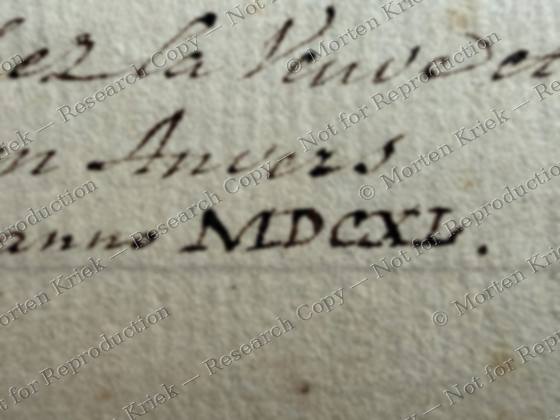
A manuscript of this kind requires a specific kind of study.
The sequence matters. Material evidence precedes textual argument. Observation precedes interpretation. Dialogue precedes publication.
Material examination first
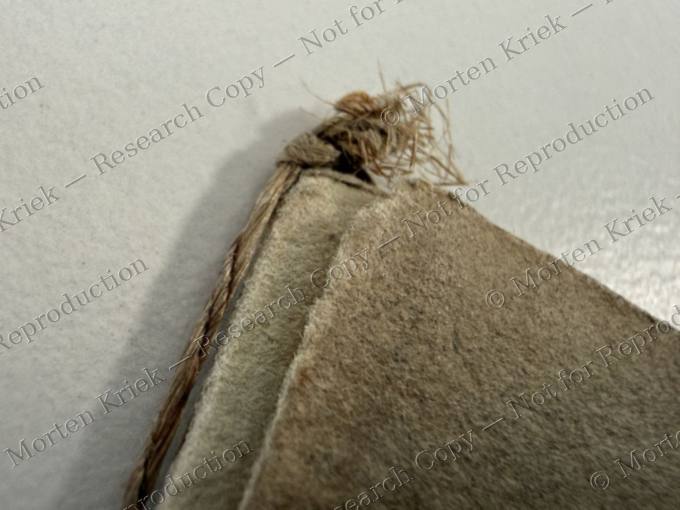
Paper, watermarks, binding, ink, and physical structure must be assessed before textual conclusions can be drawn. Material evidence is among the most datable and least deniable — the foundation on which any textual argument must rest.
Textual comparison without premature conclusions
The manuscript must be read against each known witness individually — entry by entry, spelling by spelling, in sequence. Divergences are recorded as observations, not claims. The comparison must be exhaustive before any interpretation is offered.
Scholarly dialogue before publication
The strongest research emerges from friction with expert opinion. The project seeks engagement from art historians, paper specialists, and archivists before committing to findings that will be difficult to revise in print. That conversation is what this site exists to invite.
The only handwritten witness currently known to this project — and the only one that names Jean van Meurs.
A scoped claim. No handwritten copy of the Spécification appears in the published scholarly record reviewed to date — including Rooses (1888), Muller (1975), and the current Rubenshuis & Rubenianum literature. The project actively welcomes notice of any other manuscript witness.
· · ·Every other contemporary witness to the Rubens estate catalogue is printed. This one is not. Its colophon closes, in the document’s own hand, with the name Jean van Meurs.
A factual presentation of the manuscript under review
The following summary states what is currently known or provisionally established. Features under active investigation are identified as such.
How to read the status field. Established indicates an observation directly verifiable from the manuscript itself. Provisional indicates a reading or inference consistent with current evidence but subject to revision through further study or scholarly review. Under examination indicates a feature currently being investigated, with no working position yet stated.
Custody & provenance
The manuscript is held in private possession by a European private collector and made available to the project for examination, research, and selective scholarly review.
Earlier provenance is not currently established. No prior owner, library mark, or institutional record has yet been identified. Investigation of this period is an open research task.
The manuscript remains in continuous private custody with a single Belgian collector for approximately forty years. Transfer to the present custodian in 2025 is documented by acquisition record.
Manuscript enters the present private possession. Initial direct examination confirms French cursive hand, pencil-ruled margins, 19 manuscript pages, 314 numbered paintings entries, and a closing colophon dated MDCXL.
Comparative textual analysis is undertaken against the four known witnesses. Preliminary scholarly consultation is opened, including initial dialogue with the Rubenshuis & Rubenianum, Antwerp.
Material study, watermark identification, and external scholarly consultation continue. Institutional collaboration is under discussion. All findings are recorded as observations pending peer review before formal publication.
One feature, fully shown.
This panel demonstrates the methodology that governs every entry in the project archive: image evidence, diplomatic transcription, normalized reading, English translation, and commentary. The colophon is shown here because it carries the manuscript’s single most consequential detail — the name Jean van Meurs, written in the manuscript’s own hand.
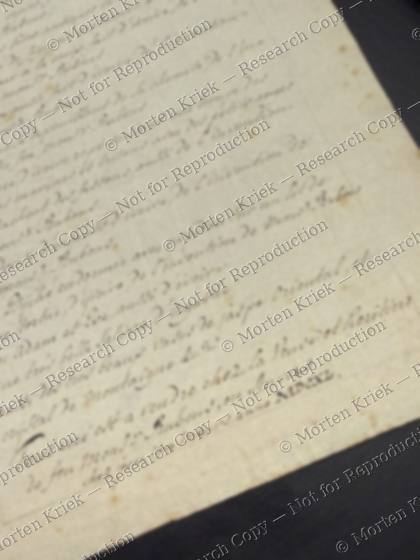
The closing colophon is transcribed and translated in full — diplomatic transcription, normalized reading, and English rendering — in the project research record. The complete text is made available to qualified enquirers under agreed terms rather than published openly here.
The colophon performs three independent functions in one sentence. It names the vendors — the widow and heirs of Rubens. It specifies the location — Antwerp. And it identifies the named party Jean Van Meurs: the same printer Jeffrey Muller identified in 1975 as having produced the Bibliothèque nationale copy of the printed Spécification. Here the name appears in handwriting, in the manuscript’s own closing line. The year MDCXL is set in a more formal, upright script than the surrounding cursive — visibly distinct from the body hand and consistent with the conventional treatment of dates in seventeenth-century scribal practice. Whether the colophon reflects a working model for the printed edition, a parallel preparation, or an independent strand of transmission is among the questions this project exists to address.
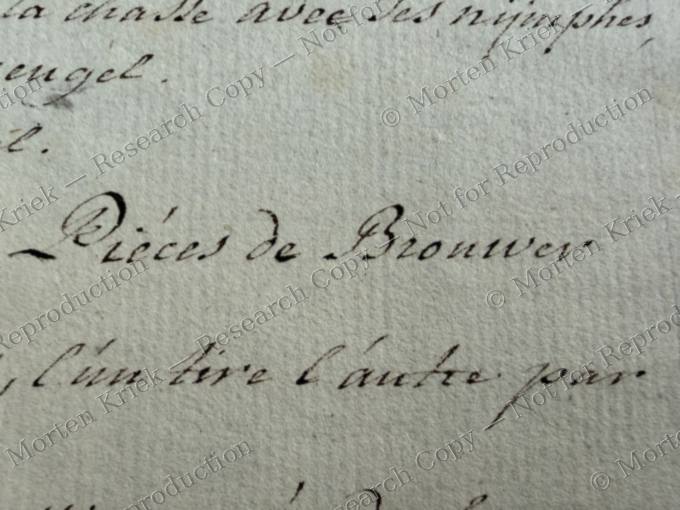
Textual tradition
Comparison with known catalogue witnesses may clarify the manuscript's place within the wider Rubens inventory tradition and reveal copying layers or editorial intervention.
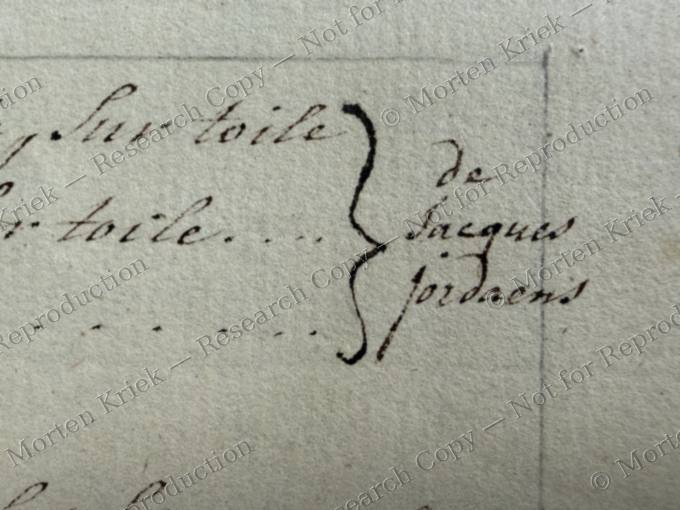
Layout and ruling
The visible structure of the pages — pencil-ruled boxes, margin geometry, page architecture — may preserve evidence of copying or ordered preparation practices.
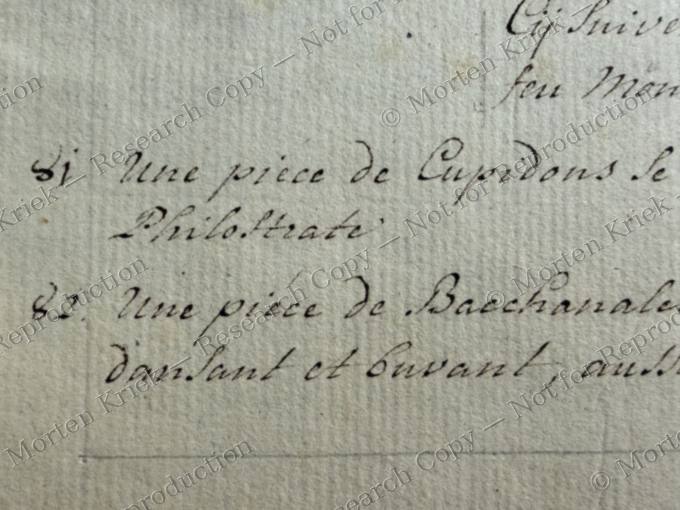
Numbering and sequence
The entry structure invites detailed comparison with later versions and institutional copies. Numbering anomalies may illuminate the catalogue's transmission history.
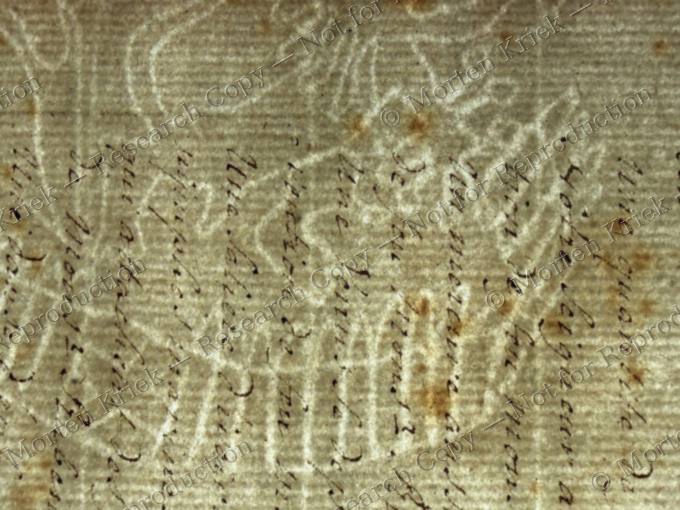
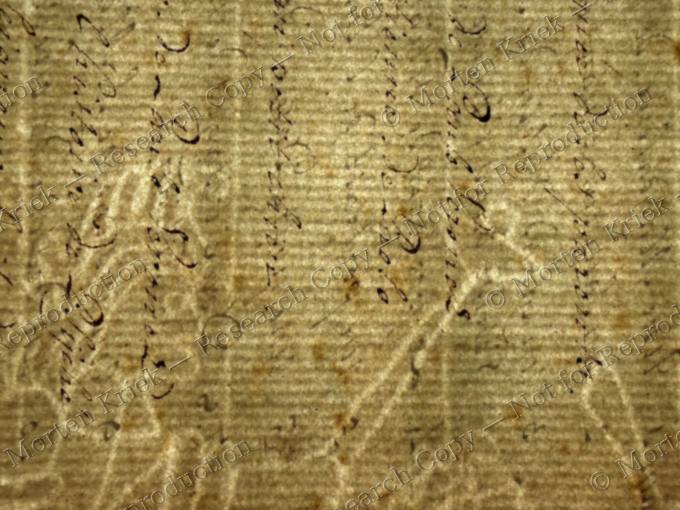
Paper and watermarks
Material examination may establish chronology, paper origin, and relationship to other documentary witnesses. Watermark evidence is particularly significant for dating.
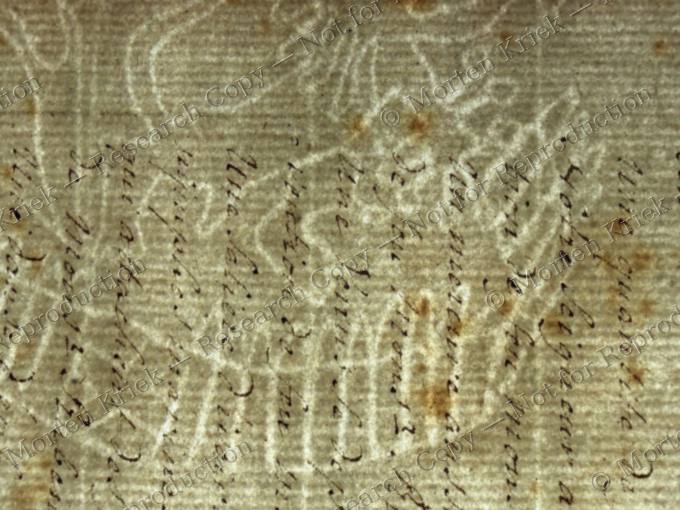
A fragment can say enough.
Public disclosure should focus on carefully selected visual evidence: fragments of paper, ink, layout, numbering, and material structure.
This allows serious viewers to assess the nature of the object while preserving the integrity, rarity, and publication value of the full manuscript.
“The object is best understood through its physical character. Images will be released incrementally as research develops.”
Visual material will be released incrementally as the research develops. Each image published here will be chosen for what it reveals about method and physical character — not for what it discloses of content. The manuscript itself remains protected until the appropriate scholarly context for its full presentation has been established.
Open questions
The project welcomes informed discussion around the following areas. These are research prompts, not conclusions.
What is the relationship between this manuscript and the known printed or manuscript witnesses of the Rubens estate catalogue?
Can the paper, watermarks, and physical structure help establish a narrower date range, confirming or refining the c.1640 attribution?
Do textual variants reveal copying practices, translation layers, or later editorial intervention within the catalogue tradition?
How does the order and numbering of entries compare with institutional examples — and what do any anomalies indicate?
What does the manuscript reveal about the afterlife of Rubens’s collection and the reception of his reputation?
Could the layout preserve evidence of preparation, copying, correction, or later collation with other sources?
The documentary tradition and this research
A chronological orientation: from Rubens’s death in 1640 through the known history of the catalogue tradition, to the current state of this project.
Rubens dies in Antwerp on 30 May. His estate and collection enter a documented posthumous inventory tradition that would circulate across the seventeenth century.
Catalogue and inventory traditions circulate in manuscript and printed form. The relationship between witnesses remains incompletely understood by scholarship.
Later references and copies contribute to the known reception history of the Rubens catalogue tradition. Institutional holdings are assembled across Europe.
Manuscript comes into private possession. Initial examination confirms French cursive hand, pencil-ruled margins, 19 pages, 314 numbered paintings entries, and a closing colophon dated MDCXL. Preliminary contact with scholars begins.
Comparative textual analysis undertaken across four witnesses. A series of substantive divergences identified across the witnesses, including iconographic variants, attribution differences, and single-word readings with material scholarly implications. Institutional dialogue opened with Rubenshuis & Rubenianum, Antwerp.
Material examination, watermark study, and external scholarly consultation continue. Research notes in preparation. Formal collaboration under discussion.
Three centuries of scholarship — one consistent finding.
Three independent scholarly sources, spanning 1888 to the present, each cite the Spécification des Peintures as a primary document — and none of them knew this manuscript existed.
L’Œuvre de
P.P. Rubens
Max Rooses · Vol. II
Antwerp, 1888
L’Œuvre de P.P. Rubens, Vol. II, Jos. Maes, Antwerp
Rooses, Conservator of the Plantin-Moretus Museum, cites the Spécification at least three times as a primary provenance source — for a head of St. John (no. 77), the Actes des Apôtres (nos. 71–75), and two Van Eyck portraits (nos. 179–180). His five-volume catalogue remains a foundational reference for Rubens scholarship.
↓ Download from Internet Archive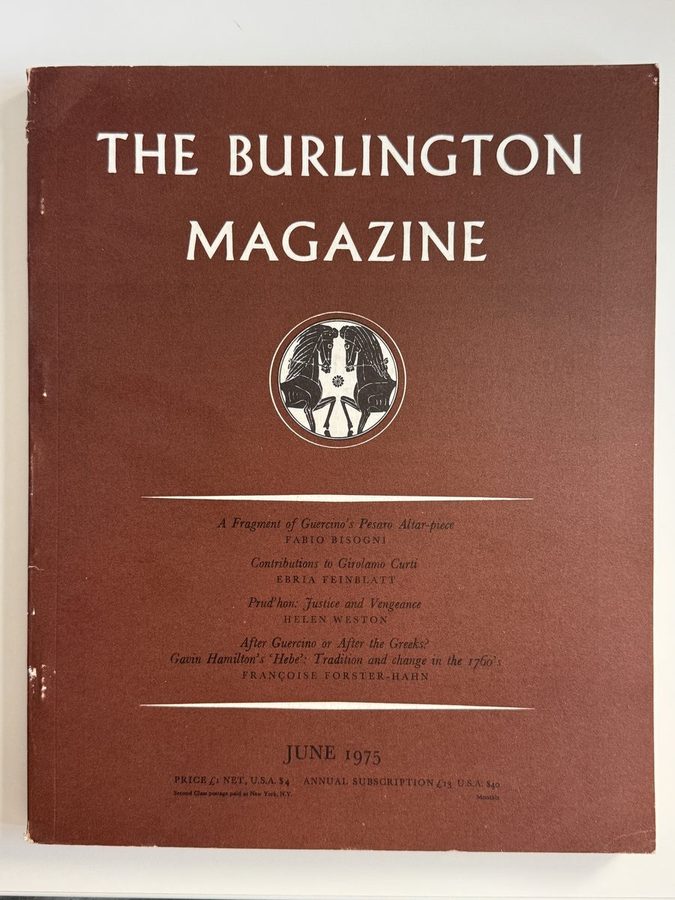
Burlington Magazine, June 1975, p. 371, fn. 1
“Oil-Sketches in Rubens’s Collection” — the critical article that established the BnF copy as the sole known witness to the Spécification. Muller identified the printer (whose name he renders Jan van Meurs), transcribed the BnF text, and concluded: “the only known copy is in the Bibliothèque Nationale, Paris.”
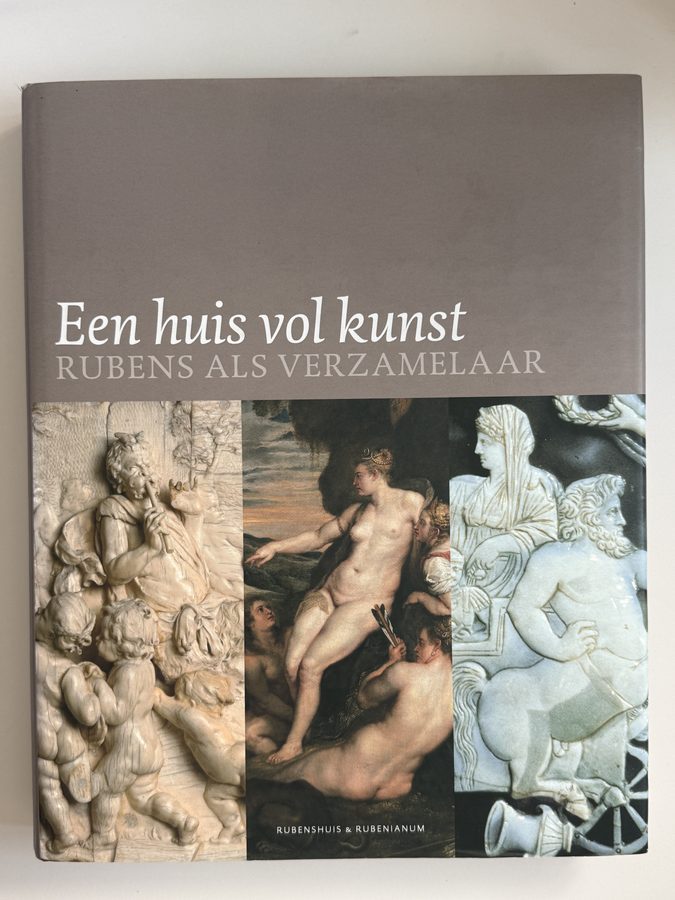 Rubenshuis & Rubenianum, Antwerp
Een huis vol kunst: Rubens als Verzamelaar, p. 11
The institution that owns Rubens’s house confirms: “het enige nog bestaande exemplaar van de Franse vertaling die tijdens de winter van 1640–41 werd gedrukt” — the only surviving copy of the French translation. Published independently of Muller, the same finding.
From Rooses in 1888 to Muller in 1975 to the Rubenshuis catalogue, every significant scholarly treatment of the Rubens estate inventory has worked from a single printed copy. The document was printed by Jean van Meurs in Antwerp in 1640. One copy survives, in Paris. No manuscript version was known to exist.
This handwritten manuscript — in French, dated MDCXL in its own hand, closing with the name of the printer Van Meurs in its colophon — was unknown to all three. It is not a copy of the BnF witness. Whether it predates the printed edition, derives from a common source, or represents a separate tradition is the question this project exists to answer.
“Spécification des peintures trouvées à la maison mortuaire…”
Rooses, 1888 — citing as primary source
“The only known copy is in the Bibliothèque Nationale, Paris.”
Muller, Burlington Magazine, 1975, p. 371
“Het enige nog bestaande exemplaar van de Franse vertaling…”
Rubenshuis & Rubenianum, Een huis vol kunst, p. 11
Open questions framing the enquiry
Each of the following will form the basis of a short, carefully considered research note — one question, one observation, one fragment of evidence. None will publish the manuscript. Each will advance the scholarly conversation.
“Morion” or “moine”? A single-letter divergence with iconographic consequence
One entry in the manuscript reads morion en tête — a crested helmet — where another witness has moine en tête — a monk. The entry describes a Van Dyck copy after Titian’s portrait of Charles V; the morion reading aligns precisely with Titian’s original. A single letter separates an accurate visual description from a misreading. Which witnesses carry which reading, and what that implies about their relationship to a common source, is among the questions this project exists to answer.
The pencil-ruled boxes and page architecture
Each page was prepared with pencil-ruled boxes and margin guides before the entries were written. The consistency and geometry of this preparation may reveal whether the scribe was copying from an existing document or composing from dictation — two very different implications for the manuscript's origin and date.
Numbering anomalies and catalogue sequence
The entry numbers do not run entirely smoothly against the printed witnesses. Whether gaps, repetitions, or reorderings represent scribal error, deliberate editorial choice, or evidence of a different source tradition is central to understanding the manuscript's relationship to the known printed editions.
Watermark observations and paper evidence
Watermarks, chain lines, and physical dimensions provide some of the most reliable dating evidence available to manuscript study. Watermark identification is underway. Comparison with established repertories may establish place and approximate period of paper manufacture, contributing independently to the c. 1640 attribution.
Comparing one entry across all four witnesses
A close comparison of a single entry — one that appears in all four known witnesses — exposes the relationship between them more clearly than any broad survey. Small differences in wording, sequence, and attribution accumulate into evidence about the manuscript's position within the tradition.
Why controlled disclosure protects scholarship
The decision to publish incrementally is not caution for its own sake. A manuscript disclosed in fragments without peer review loses a form of scholarly credibility that cannot be recovered. This note reflects on the relationship between restraint, publication value, and the integrity of the research record.
One tradition. Four objects. 192 years.
The same inventory of paintings found in Rubens's house at his death in 1640 survives in four distinct witnesses — handwritten and printed, French and English, spanning nearly two centuries of transmission. Each tells a different story about how Rubens's collection was remembered, recorded, and used.
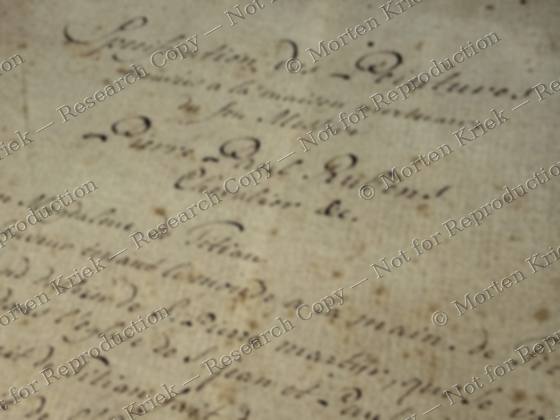
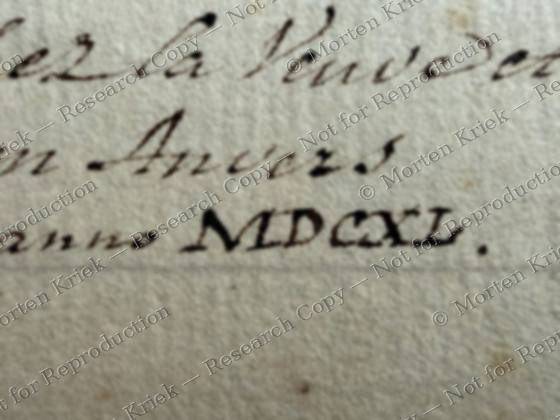
The title reads Spécification des Peintures trouvées à la maison mortuaire du feu Messire Pierre-Paul Rubens, Chevalier &c. — a handwritten document in a fluent seventeenth-century cursive hand, with pencil-ruled margins and numbered entries throughout. The date MDCXL appears in a more formal hand at the close of the document.
This manuscript is potentially the oldest surviving witness in the tradition, and the only one in manuscript form so far recorded. Although titled Spécification des Peintures, the manuscript extends well beyond the 314 numbered paintings entries. It continues with unnumbered sections covering drawings, copies after originals, antique marble heads, modern figures, ivory sculptures from Rubens's own designs, and decorative objects including an agate piece and Oriental jasper vases. In scope it is among the most comprehensive of the known witnesses.
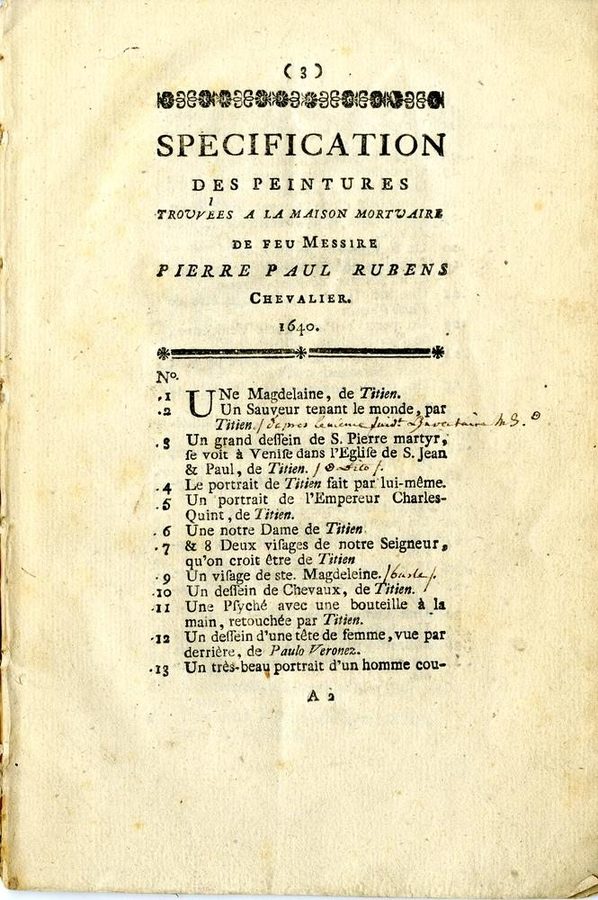
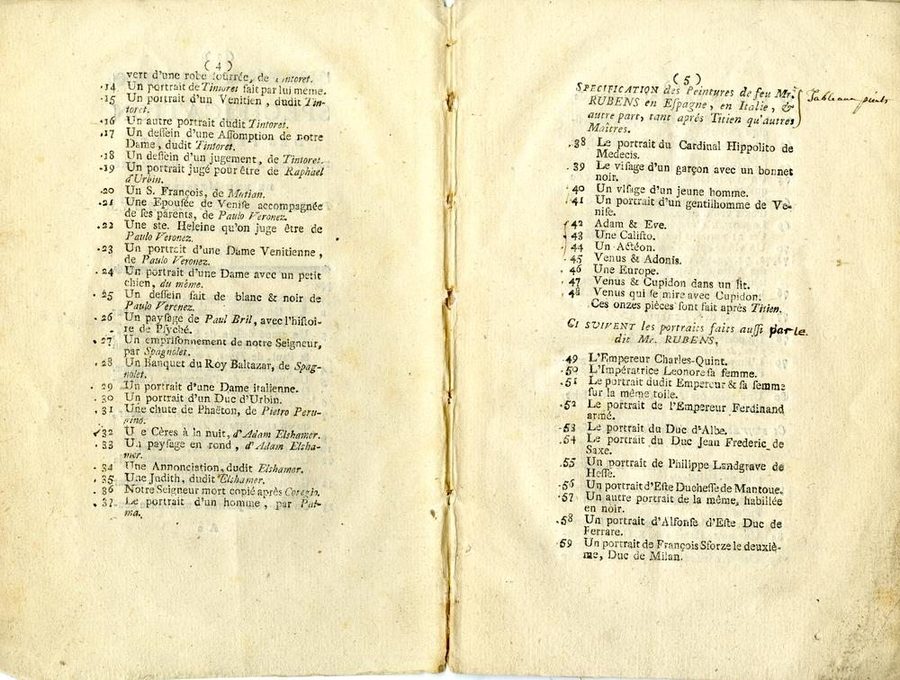
Comparative witness image © The Trustees of the British Museum, reproduced under public-access terms.
The British Museum copy is a printed edition whose outer title — Catalogue des Tableaux, Desseins et Sculptures en Marbre, Ivoire et Pierres Precieuses — is notably broader in scope than the manuscript. But its inner title page opens with the same phrase: Spécification des Peintures trouvées à la Maison mortuaire de feu Messire Pierre Paul Rubens, with the date 1640 set in type beneath.
The copy is heavily annotated in a contemporary hand, with marginal notes beside individual entries. Whether these annotations reflect price records, ownership marks, or comparative notes from another witness is a matter for further study. The annotated copy represents the catalogue in active scholarly or commercial use close to 1640.
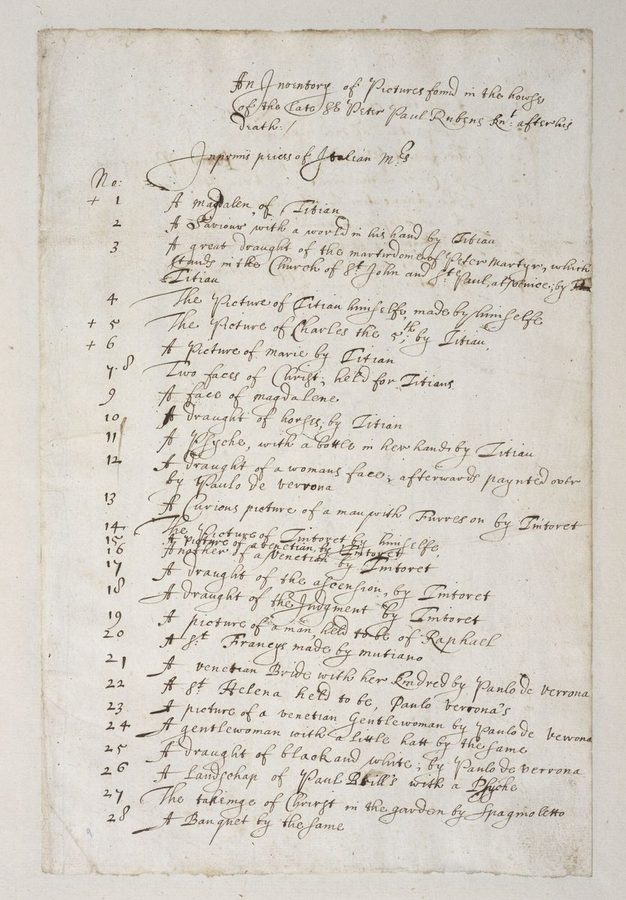
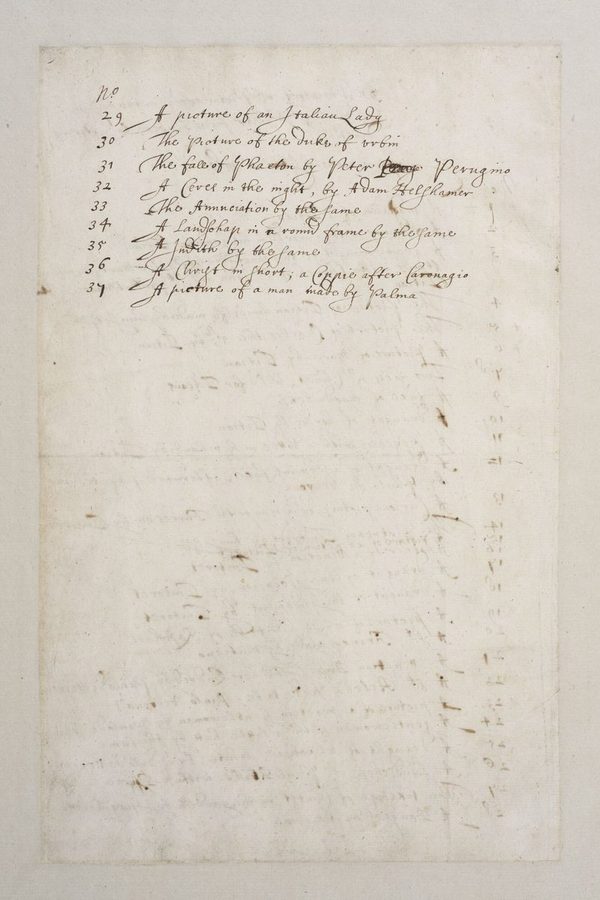
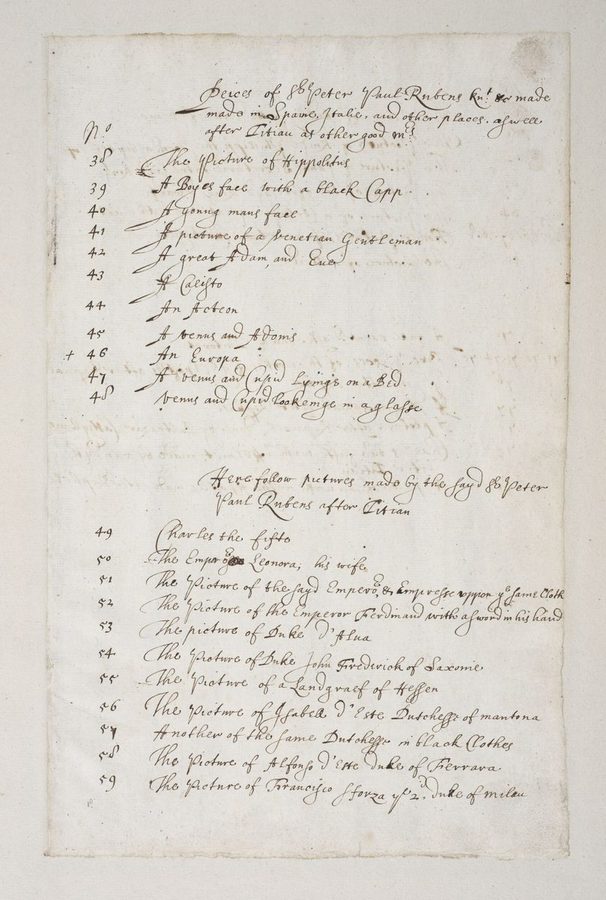
Comparative witness image reproduced courtesy of The Courtauld Institute of Art (MS 1978.PG.2).
The Courtauld manuscript is the most complex of the four witnesses. Its calligraphed title page — "A Catalogue of The Works of Art in the possession of Sir Peter Paul Rubens at the time of his decease, together with an unpublished letter from himself and two from Sir Balthasar Gerbier. 1640" — announces it as a scholarly compilation rather than an original inventory. A slip inside records its provenance: "Dawson Turner, a present from his friend, [1832]."
It contains an English translation of the 1640 inventory (314+ entries), followed by three letters: two from Sir Balthasar Gerbier written from Brussels in 1640, one dated 2 June — three days after Rubens died — and one in French which may be the unpublished Rubens letter referenced in the title. The Gerbier letter of 2 June is one of the earliest eyewitness accounts of Rubens's death: "S[i]r Peter Rubens is deceased three dayes past, so as Jordaens remaynes the prime painter here."
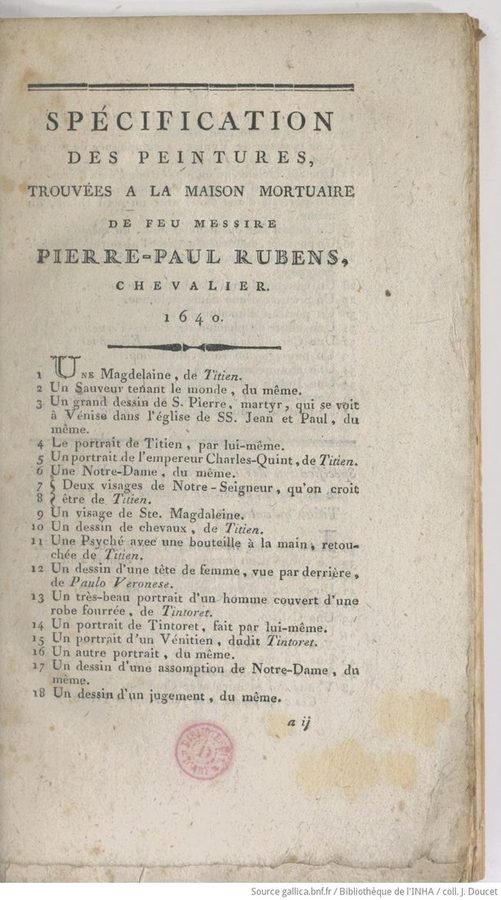
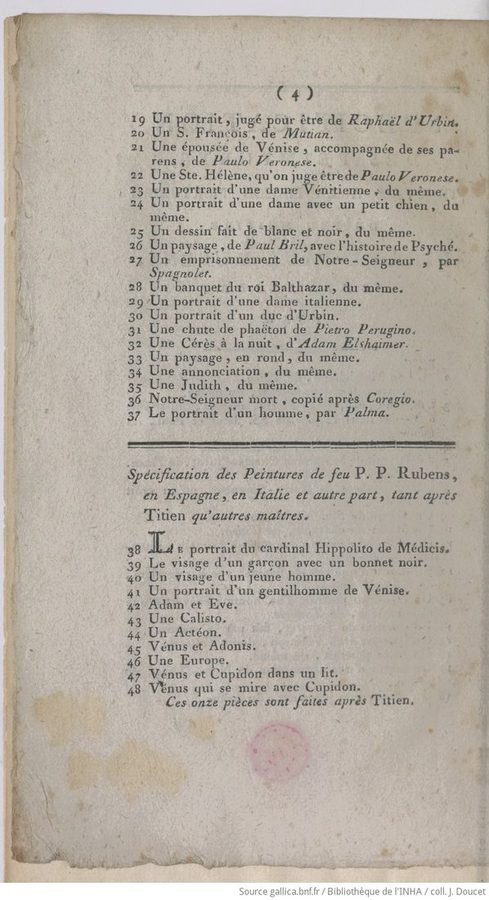
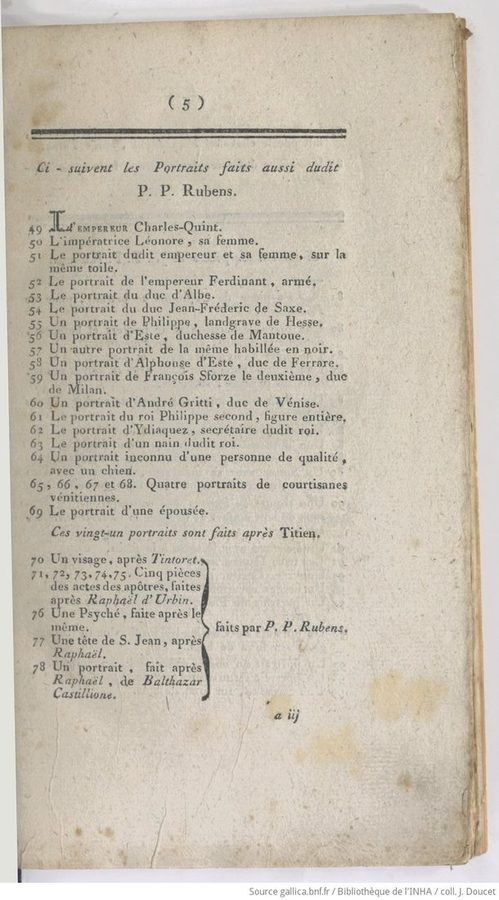
Comparative witness image © Bibliothèque nationale de France / Bibliothèque de l’INHA, reproduced under public-access terms.
The Del-Marmol edition of 1794 is the latest of the printed witnesses. Its outer title — Catalogue de la plus précieuse collection d'Estampes, de P.P. Rubens et d'A. Van Dyck — reveals its context: the 1640 catalogue is reprinted here as a preface to a sale catalogue of Rubens and Van Dyck prints, assembled by Del-Marmol, a Counsellor to the Sovereign Council of Brabant. The Rubens inventory appears inside as a scholarly appendix, under the same Spécification des Peintures title, running to 271+ numbered entries.
That this edition appeared in 1794 — 154 years after the original inventory and in the midst of the Revolutionary period — speaks to the enduring scholarly and commercial interest in the Rubens collection. The copy in the BnF / Bibliothèque de l'INHA (coll. J. Doucet) bears library stamps indicating its institutional history.
What the four witnesses share — and where they diverge
These observations frame the research questions. They are not conclusions.
| Witness | Date | Language | Scope | Key distinction |
|---|---|---|---|---|
| The manuscript | c. 1640 | French | Paintings, drawings, sculpture & decorative objects | Only witness in manuscript form so far recorded; potentially among the earliest; broadest in scope; not recorded in the published scholarly literature reviewed to date |
| British Museum | c. 1640 | French | Paintings, drawings, sculpture | Printed; handwritten annotations throughout; broader title |
| Courtauld MS 1978 | c. 1832 | English | Full inventory + letters | English translation; includes Gerbier letters; Dawson Turner provenance |
| BnF Del-Marmol | 1794 | French | Full inventory | 154 years later; prefaced a print sale catalogue; identified by Muller (1975) as “the only known copy” |
One entry. Four witnesses. One letter of difference.
The entry below describes a Van Dyck copy after Titian’s portrait of Emperor Charles V. It appears in all four known witnesses. The divergence between morion and moine is one letter — and a difference that separates an accurate visual description from a misreading of the same painting.
“L’Empereur Charles quint avec un morion en tête fait par le Chevalier Van Dijck après Titian”
Emperor Charles V with a crested helmet (morion) on his head, made by Sir Van Dyck after Titian. The morion was a distinctive element of Titian’s original portrait; the reading is iconographically accurate.
“L’Empereur Charles-Quint avec un moine en tête, fait par le Chevalier Van Dyck, après Titien”
Emperor Charles V with a monk (moine) on his head. The reading is iconographically inconsistent with Titian’s original. The single-letter divergence — morion / moine — may indicate independent copying from a common source rather than direct transmission from one witness to another.
This is one of seventeen or more substantive divergences identified in preliminary comparative analysis. The full comparison, entry by entry across all four witnesses, is part of the active research programme.
“The manuscript does not simply repeat what is already known. It introduces evidence that the known witnesses cannot account for. That is why it merits careful study.”
Access is selective. Conversation is the first step.
Qualified scholars, curators, conservators, paper specialists, and institutions are invited to make contact. The form of engagement determines the level of access. All enquiries are treated confidentially.
Forms of scholarly engagement
The level of access depends on the nature of the enquiry. Each pathway below describes a distinct form of engagement and what it entails.
Informal scholarly enquiry
An initial exchange of correspondence about the manuscript, its context, or its relationship to other witnesses. No access to the physical object at this stage. Appropriate for specialists wishing to understand the research questions before committing to further engagement.
Institutional review
Selective physical access under agreed conditions for institutions with a documented research interest, conservation mandate, or publication programme related to Rubens, seventeenth-century collecting, or manuscript transmission. A brief statement of research context is required.
Material consultation
Engagement with paper historians, watermark specialists, conservators, and book historians regarding physical evidence. This pathway is specifically for specialists whose contribution relates to the material rather than textual character of the manuscript.
Access is selective. Conversation begins here.
Institutional or scholarly access to the manuscript itself is available on a selective basis. This is not a public database or an open archive.
Contact is the first step. A brief description of the research context and institutional affiliation allows the project lead, Morten Kriek, to respond appropriately and to protect the integrity of unpublished work.
Rights of first publication, first full disclosure, and first exhibition are reserved. These, together with full scholarly access to the manuscript, are available for discussion with appropriate parties.
The research is active. The enquiry is open.
This project is at an early stage. The manuscript is under examination; findings will be published incrementally as they are verified through comparison and scholarly review. Those who engage at this stage contribute to the research rather than simply receiving it. Contact is the beginning of a conversation, not a request for access.
[email protected]Make an Enquiry
Enquiries are welcome from scholars at all stages, independent researchers, curators, conservators, paper specialists, and institutions. There is no minimum credential for making contact — only a genuine interest in the research questions this project is built around.
Enquiry received
Thank you for making contact. Your enquiry has been sent to the research team at [email protected] and will be read carefully.
You can expect a considered response within a few working days.
Prefer to write directly? [email protected]
Legal Notice
Website operator
This website (rubenscatalogue.art) is operated by:
Morten Kriek
Contact: [email protected]
The site is operated on a non-commercial basis as a private scholarly research project. No goods or services are sold through this website.
Data protection (GDPR)
The operator named above is the data controller for any personal data collected through this website.
Data collected. When you submit an enquiry through the contact form, the following information is processed: name, email address, institutional affiliation (if provided), and the content of your message.
Legal basis. Article 6(1)(a) GDPR — your consent, given by submitting the form.
Purpose. To respond to your enquiry and, where appropriate, to maintain scholarly correspondence in connection with the project.
Retention. Enquiry correspondence is retained for as long as it remains relevant to ongoing scholarly engagement. You may request deletion at any time by writing to the address above.
Recipients. The form is processed via Formspree (formspree.io), which acts as a data processor on the operator’s behalf. Formspree is based in the United States; the transfer of personal data relies on the EU–US Data Privacy Framework, under which Formspree is certified. No data is transferred to third parties for marketing or unrelated purposes.
Your rights. Under GDPR you have the right of access, rectification, erasure, restriction, portability, and objection in respect of your personal data. You may exercise these rights by writing to the contact address above. You also have the right to lodge a complaint with the Dutch Data Protection Authority (Autoriteit Persoonsgegevens, autoriteitpersoonsgegevens.nl).
Cookies
This website does not use cookies.
Intellectual property
All text and original photographs on this website are the property of the project operator unless otherwise indicated. Comparative witness images are reproduced from the digitised collections of the British Museum, the Bibliothèque nationale de France, and the Courtauld Institute of Art under their respective public-access terms; rights in those images remain with the source institutions. Reuse for scholarly purposes is welcomed; please contact the operator for permissions.
Applicable law
This notice is governed by Dutch law and Regulation (EU) 2016/679 (GDPR).